
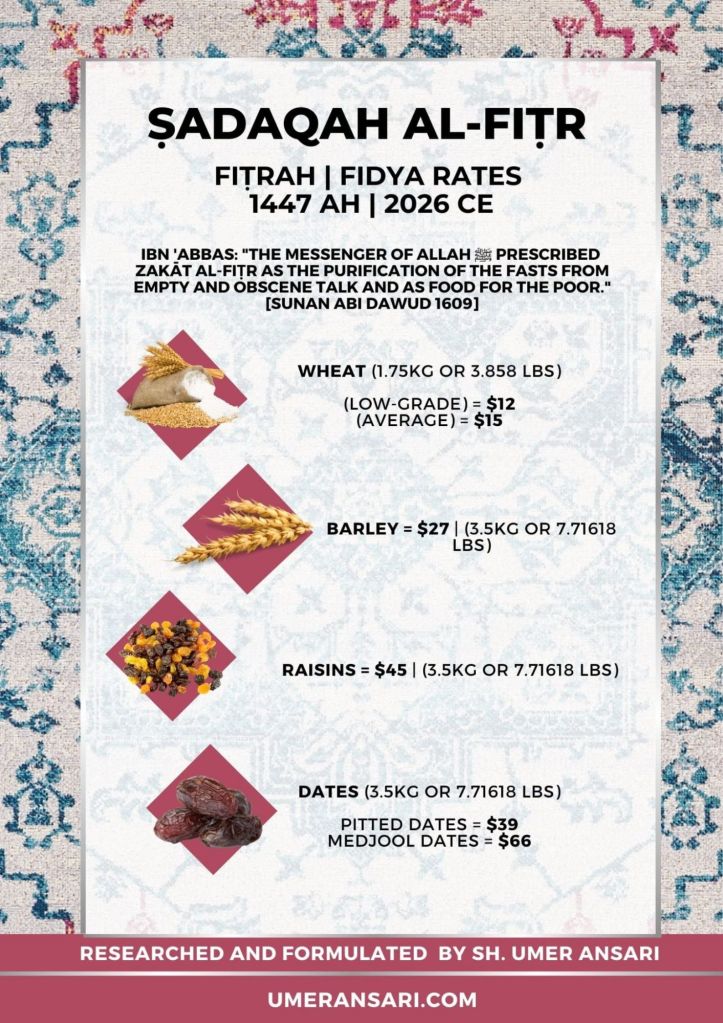
It has been a few years since I have been calculating the Zakāt al-Fiṭr, also known as Ṣadaqah al-Fiṭr, rates. Here are the rates for this Ramadan 1447 AH / 2026 CE.
One may choose any one of the four categories (wheat, barley, raisins, or dates) that is financially feasible.
When Must It Be Paid?
- It must be paid before the Eid al-Fitr prayer.
- It can be paid in advance anytime during Ramadan to ensure it reaches the poor and needy before the Eid. [Recommended]
Who Needs To Pay?
- An adult male is responsible to pay for themselves and on behalf of all the adolescent (pre-puberty) children under his guardianship. This even includes the newly born babies as long as they are born before the fajr of the Day of Eid al-Fiṭr.
- An adult woman is responsible to pay for herself. Unless, she grants permission to her husband, father, or son to dispense on her behalf.
- If a lady is a single mother with children, then she would be responsible for the payment of her adolescent (pre-puberty) children.
Upon Whom Ṣadaqah al-Fiṭr Is Obligatory?
- If Zakat is obligatory then Ṣadaqah al-Fiṭr also becomes obligatory.
- If Zakat is not obligatory, add extra assets to it and see if the value reaches the zakat threshold (niṣāb), if it reaches the niṣāb then Ṣadaqah al-Fiṭr is obligatory.
Extra assets are personal items that are in addition to the need and frequent use. They are not included in the zakat calculation, however, they do get included in the Ṣadaqah al-Fiṭr calculation, hence broadening and enlarging the giving group.
To Whom Ṣadaqah al-Fiṭr Can Be Given?
- The recipients of Ṣadaqah al-Fiṭr are the same as the regular Zakat al-Māl recipients, i.e. poor and needy Muslims.
- They should receive it before the Eid al-Fiṭr prayer in the form of food so that they have meal for the Eid. However, if one is planning to give the equivalent amount in money (fiat currency) then it should be paid in advance so that it reaches the poor believers before Eid and they have ample time to purchase the food and groceries from the stores according to their needs before the Eid.
Ruling of Sadaqah al-Fitr:
Ṣadaqah al-Fiṭr was made obligatory by the Messenger of Allah ﷺ upon every Muslim male or female, young or old, free or slave; and he stipulated it to be paid before the Eid al-Fiṭr prayer to ensure that no poor and needy believer is without food on the first day of Eid al-Fiṭr.
‘Abdullah Ibn ‘Abbas (Allah is pleased with him) narrated:
“The Messenger of Allah ﷺ prescribed the Zakāt al-Fiṭr as a purification of the fasting person from vain and obscene talk, and as food for the poor. Whoever gave before the prayer (of Eid al-Fiṭr) then it is a Zakāt that is accepted, and whoever gave it after the prayer (of Eid al-Fiṭr) then it is a ṣadaqah like a regular charitable giving.” [Sunan Abi Dawud 1609]
‘Abdullah ibn ‘Umar (Allah is pleased with him) narrated:
The Messenger of Allah ﷺ obligated the payment of Zakat-ul-Fitr (on breaking the fast) of Ramadan for people, for every freeman, or slave, male and female among the Muslims-one sa’ of dried dates, or one sa’ of barley. [Sahih Muslim 984] Then Ibn ‘Umar said that the people equated (one sa’ of dates or barley) with half a sa’ of wheat [Sahih Muslim 984c] or two mudd of wheat [Sahih Muslim 984d].
Abu Sa’id al-Khudri (Allah is pleased with him) was reported saying:
We used to take out as the Zakat of Fitr one sa’ of food (wheat grains), or one sa’ of barley or one sa’ of dates, or one sa’ of cheese or one sa’ of raisins. [Sahih Muslim 985].
Can the Ṣadaqah al-Fiṭr Be Paid In Cash? A Glimpse Into Our History:
During the blessed Prophetic Era, it was paid in the form of wheat, barley, raisins, or dates, since those were the standard staple food. It shows that the objective of the Zakat al-Fitr is to ensure everyone in the community are fed for the Eid and there is not a single believer starving or struggling to eat on Eid.
As the time progressed and the early Muslim society evolved, their staple food and needs differed. Therefore, the early Islamic jurists preferred other forms of payments keeping the interest of the poor and needy Muslims. Naturally some jurists preferred to abide by the Prophetic command literally, while others focused on the purpose of it, which was also outlined by the Messenger of Allah himself.
Hence, Abu Bakr al-A’mash used to say:
“To give wheat grains is better than giving its (monetary) value, because it is closer to the (Prophetic literal) command and farther away from the scholarly differences, therefore, it is on the side of caution.” [al-Mabsut of al-Sarakhsi, K. al-Sawm, Bab Sadaqah al-Fitr, Pg. 107]
Whereas, al-Imam al-Faqeeh Abu Ja’far al-Tahawi used to say:
“Giving the (monetary) value is better because it is closer to being more beneficial for the poor as they can purchase with it whatever they are in need of. The text (nas) stipulated wheat and barley because they were tradable goods during that time in Madinah.” [al-Mabsut of al-Sarakhsi, K. al-Sawm, Bab Sadaqah al-Fitr, Pg. 107]
Qāḍi Abu Yusuf said:
“Flour is more beloved to me than wheat, and dirhams (money) is more beloved to me than flour and wheat; because that is better in fulfilling the need of the needy.” [Badā’i al-Sanā’i of al-Kāsāni]
It is also reported from Ameer al-Mu’mineen ‘Umar ibn Abdul ‘Azeez that he allowed the Ṣadaqah al-Fitr to be paid in the form of money. [al-Musannaf of Ibn Abi Shaybah] This shows that during the Prophetic era, if someone was given wheat or barley, and they had no need for it, they could barter it in the market with something else that they needed. However, during the era of the great Imams of Islamic jurisprudence, the society had evolved where the barter of staple food had nearly disappeared from their society. Whereas today, in most of the world, especially the Western world, the barter trade is non-existence from the marketplace. Today, the staple food of the people consists of store bought bread, cereal, oats, eggs, rice, meat, juices, milk, and its like.
However, in the Hanafi Juristic School, its value can be paid in cash as well. In which case, the place where a person will pray Eid al-Fiṭr, the rates of that town will be applicable.
 Umer Ansari